+
.jpg)
+
Thunderbird Resorts and Casinos adheres to Responsible Gaming. While we aim to provide a world-class gaming experience, we are also committed to direct the people with gaming problems to help services and prevent underage. As such, guests below 21 years old are not allowed to play. We are also committed to averting other gaming related problem. Here are a few indications. That you might have a gaming problem:
THUNDERBIRD RESORTS & CASINOS SUPPORTS RESPONSIBLE GAMING.
For more information visit https://www.pagcor.ph/regulatory/responsible-gaming.php
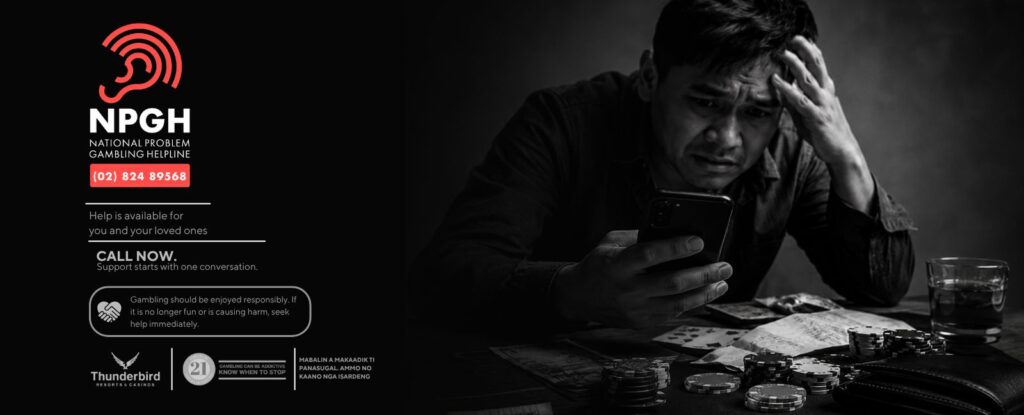
For immediate professional assistance, call the National Problem Gambling Helpline +632 8248 9568
For professional support from counsellors through Pagcor’s accredited help centers, contact the following:
Bridges of Hope Drugs and Alcohol Rehabilitation Foundation, Inc.
364 Aguirre Ave., Phase 3, BF Homes, Parañaque City (with branches nationwide)
Contact: (02) 622-0193 / 0917 509 8826
Email: help@bridgesofhope.com.ph
Website: www.bridgesofhope.com.ph
Life Change Recovery Center
105 Scout Rallos St., Kamuning, Barangay Sacred Heart, Quezon City
Contact: (02) 415-7964 / 415-6529
Website: www.lifechangerecovery.com
Milestone Health and Wellness Center
58 Paterno St., South Drive, Baguio City
Contact: 0919 000 9188
Website: www.milestonehealthcenter.com
Gamblers Anonymous Philippines
Contact: 0915 938 2808
Website: www.gaphilippines.com
For individuals who wish to voluntary exclude themselves from gambling activities, you may apply at PAGCOR’s Online Self-Exclusion Application (OSEA) at https://OSEA.pagcor.ph
FAQs
Gaming refers to games of chance involving wagering odds and prize commonly played in casinos and any variations thereof.
“Responsible Gaming” is a program that Thunderbird Resorts and Casinos seriously upholds preventing underage people from playing and helping those who may not have control over their playing.
You might play in secret, lie about how much you play, feel that others will not understand you, or feel that you will not understand you, or feel that you will surprise people with a big win.
Once you start gaming, you find it hard to walk away. You are compelled to play until you’ve spent your last peso, upping your bets in a bid to win lost money back.
A red flag is when you are getting more and more desperate to recoup your losses. You may play until you’ve spent your last peso and then move on to spending money you don’t’ have (e.g., using credit cards) or money intended for other purposes (e.g., to pay bills, for your children’s needs). You may feel pushed to borrow, sell, pawn, or even steal things for gaming money. It is a vicious cycle. You may sincerely believe that having gaming money is the only way to win lost money back. But it only puts you further and further in the hole.
Denial keeps problem gaming going. If your friends and family are worried, listen to them carefully. Take a hard look at how gaming is affecting your life. It is not a sign of weakness to ask for help. Many older players are reluctant to reach out to their adult children if they have played away their inheritance.
But it is never too late to make changes for the better.
Thunderbird Resorts & Casinos cares, and if you want to exclude yourself or a loved one from playing in our casino, you may do so for a period. All you need to do is apply for self -exclusion of your loved one.
You can apply for exclusion by accomplishing the Self-Exclusion/ Family Exclusion Form available at https://www.pagcor.ph/regulatory/responsible-gaming.php. Submit this application along with other exclusion requirements specified in the https://www.pagcor.ph/regulatory/responsible-gaming.php.
You will also need to provide government-issued proof of kin (i.e., marriage certificate, birth certificate, or license).
No. Once you chose to exclude yourself, the exclusion is irrevocable for the first six months until the end of the period you have indicated. Family initiated exclusion is irrevocable for three months.
Since you will not be playing during this period, this may course your VIP level to lapse, as it would if you simply didn’t play anymore.
You may visit https://www.pagcor.ph/regulatory/responsible-gaming.php
email: ResponsibleGaming@pagcor.ph
website: www.pagcor.ph/regulatory/responsible-gaming.php
National Problem Gambling Helpline: (02) 824 89568